Red light therapy is becoming increasingly visible across the equestrian world, from competition yards and rehabilitation facilities to everyday horse owners looking for convenient ways to support their horse's recovery and wellbeing.
But what does equine red light therapy actually do? How is it different from laser therapy? Which wavelengths matter? And, importantly, what does the scientific evidence really tell us?
This complete guide explains the technology, its potential applications and how it can be incorporated responsibly into a modern equine wellness routine.
What Is Equine Red Light Therapy?
Equine red light therapy uses specific wavelengths of red and near-infrared light directed towards the horse's body.
The wider scientific term is photobiomodulation, often shortened to PBM.
Unlike heat lamps, photobiomodulation devices are designed to deliver controlled wavelengths of light to the body. Depending on the device, the light may be delivered through:
- LED panels
- Flexible therapy wraps
- Equine leg boots
- Handheld devices
- Overhead full-body systems
- Laser-based equipment
Red and near-infrared wavelengths interact differently with tissue, which is why many modern therapy devices combine more than one wavelength.
How Does Red Light Therapy Work?
When light reaches tissue, some photons can be absorbed by molecules within cells.
One of the main proposed mechanisms involves structures within the mitochondria—the parts of cells involved in producing cellular energy.
Photobiomodulation research suggests this interaction may influence cellular signalling, circulation and inflammatory processes.
However, it is important to distinguish proposed biological mechanisms from guaranteed clinical outcomes.
Veterinary research has investigated photobiomodulation for areas including musculoskeletal conditions, wounds, neurological conditions and pain. A systematic review of veterinary laser and LED research found some positive findings, but also significant inconsistencies between studies and limitations in the quality of available evidence.
That means responsible equine light therapy should be viewed as a supportive technology, not a replacement for veterinary diagnosis or treatment.
Red Light vs Near-Infrared Light
One of the most important things to understand when choosing an equine therapy device is wavelength.
Red Light
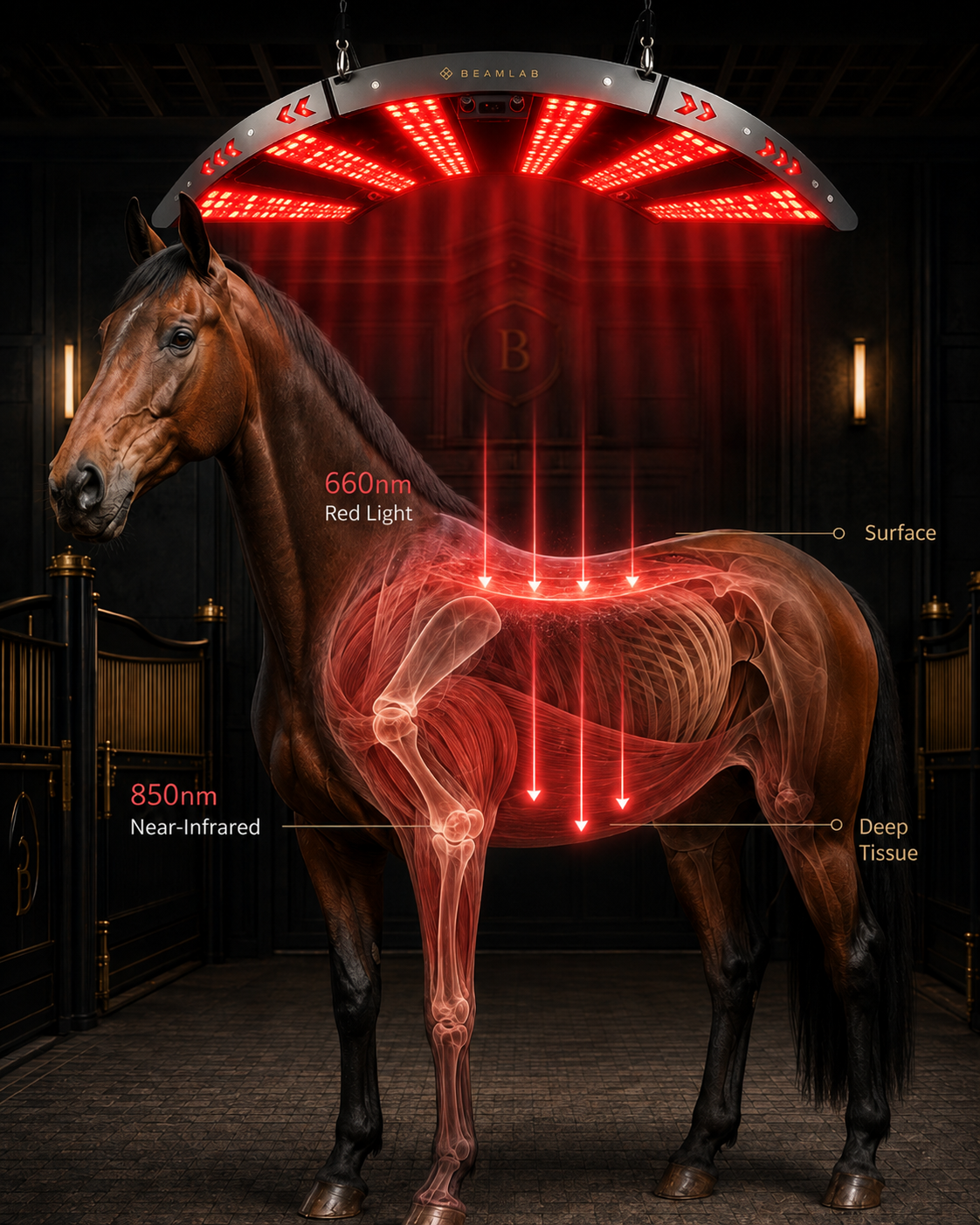
Visible red wavelengths are commonly found around the 600–700nm range.
They are generally absorbed more superficially than longer near-infrared wavelengths and are commonly used in photobiomodulation applications involving the skin and tissues closer to the surface.
Near-Infrared Light
Near-infrared—or NIR—light sits beyond the visible spectrum.
Common photobiomodulation wavelengths include approximately:
- 810nm
- 830nm
- 850nm
- 940nm
Near-infrared light can penetrate more deeply through tissue than visible red light.
This is why many equine devices combine red + near-infrared technology, allowing treatment to reach tissue at different depths.
Why Is Light Penetration Important in Horses?
A horse is very different from a human.
Treatment light may need to pass through:
- Hair
- Skin
- Subcutaneous tissue
- Muscle
before reaching deeper structures.
Research specifically examining photobiomodulation penetration through equine skin has demonstrated that device design, energy output and even skin pigmentation can influence the amount of light transmitted through tissue.
This is an important point because wavelength alone doesn't determine whether a device is effective.
Other factors matter too.
These include:
- Irradiance
- Distance from the horse
- Treatment duration
- Total dose
- LED power
- Treatment coverage
- Hair thickness
- Skin pigmentation
- Device positioning
That is why comparing two equine red light therapy products based solely on the number of wavelengths can be misleading.
What Are the Potential Benefits of Equine Red Light Therapy?
Horse owners commonly incorporate photobiomodulation into routines aimed at supporting:
Post-Exercise Recovery
Light therapy can be used after training alongside appropriate cooling down, hydration, nutrition and rest.
Muscle Wellness
Large-area therapy systems are particularly suited to covering major muscle groups through the back, shoulders, quarters and neck.
Everyday Mobility
For older or heavily worked horses, light therapy may form part of a broader routine designed around maintaining comfortable movement and activity.
Competition Recovery
Performance horses experience repeated loading through muscles, joints, tendons and supporting structures.
A convenient therapy system allows riders to introduce light therapy without adding additional physical demands to the horse.
Rehabilitation Programmes
Photobiomodulation is sometimes used alongside veterinary rehabilitation, physiotherapy and controlled exercise programmes.
Any horse recovering from an injury should be managed under appropriate veterinary or professional guidance.
What Does the Research Say?
This is where marketing claims need to be handled carefully.
The scientific evidence surrounding photobiomodulation in horses is promising in some areas but currently mixed overall.
A major systematic veterinary review examined 45 studies across horses, dogs and cats. Researchers found some beneficial outcomes but concluded that there was not yet enough consistent, high-quality evidence to establish reliable clinical protocols across most conditions.
One major reason is that studies use very different:
- wavelengths,
- power levels,
- doses,
- treatment times,
- devices,
- and treatment frequencies.
Equine Muscle Research
One study investigating photobiomodulation on horses' back and gluteal muscles found changes in muscle firing patterns after treatment, although there was no significant improvement in mechanical pain thresholds.
This illustrates why research needs to be interpreted carefully.
A study showing a measurable physiological change doesn't automatically mean every horse will experience a noticeable improvement.
Equine Wound Research
A randomised controlled study looked at red and near-infrared LED therapy on experimental wounds in eight horses.
Researchers found no clinically relevant improvement in wound size, swelling or overall healing compared with untreated control wounds.
This is particularly important because it demonstrates why brands should avoid making claims that red light therapy heals injuries or wounds.
Good equine wellness marketing should reflect the science rather than exaggerate it.
Red Light Therapy for Horse Legs
The lower legs are one of the most popular areas for targeted equine light therapy.
Wearable LED boots can allow light to be applied around areas such as the:
- Cannon
- Fetlock region
- Tendon area
- Lower limb
The main advantage is convenience.
A well-designed cordless therapy boot can simply be fitted during stable time rather than requiring the horse to remain beside a large stationary machine.
This makes equine leg devices particularly attractive for:
- Competition horses
- Horses in regular training
- Older horses
- Horses within professionally supervised rehabilitation programmes
They should not, however, be used to disguise or delay investigation of swelling, heat, pain or lameness.
Full-Body Equine Red Light Therapy
Targeted boots and wraps are useful when you want to concentrate light on one specific area.
But horses are large animals.
For broader recovery routines, full-body systems offer a different advantage: coverage.
An overhead equine therapy device can illuminate larger areas of the horse simultaneously, including areas around the:
- Back
- Neck
- Shoulders
- Quarters
- Major muscle groups
This reduces the need to reposition multiple small devices around the horse.
For busy owners, trainers and professional yards, convenience matters because a recovery method is only useful when it can realistically be used consistently.
Introducing BeamBar™
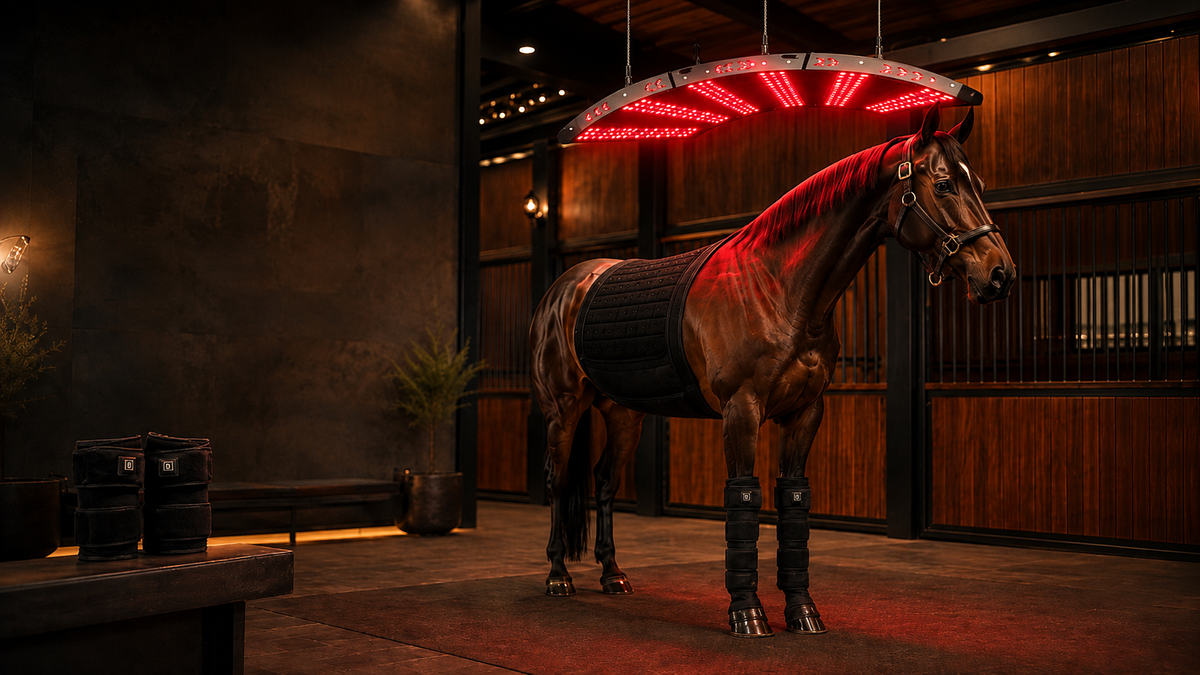
BeamBar™ has been developed around the concept of convenient, premium overhead equine light therapy.
Rather than holding or repeatedly repositioning smaller devices, BeamBar is designed to provide broad overhead coverage while the horse stands comfortably beneath the system.
The result is a more streamlined approach to incorporating light therapy into the stable environment.
BeamBar is particularly suited to:
- Competition yards
- Performance horses
- Equine rehabilitation environments
- Professional trainers
- Equine wellness professionals
- Owners wanting broader treatment coverage
BeamBar™ is launching soon.
Priority List members will receive first access and exclusive launch pricing.
To join the BeamBar Priority List, email: info@beamlab.co.uk
Equine Red Light Therapy for Senior Horses
Older horses may particularly benefit from a carefully considered management programme.
As horses age, priorities often shift towards:
- Maintaining movement
- Appropriate exercise
- Weight management
- Comfortable turnout
- Nutrition
- Hoof care
- Physiotherapy
- Veterinary monitoring
- Recovery
Red and near-infrared light therapy can be incorporated alongside these measures as part of an overall wellness routine.
It should not replace appropriate diagnosis or treatment for conditions such as arthritis, lameness or other age-related problems.
Equine Red Light Therapy for Competition Horses
Recovery can be just as important as training.
Performance horses repeatedly experience physical loading during disciplines including:
- Dressage
- Showjumping
- Eventing
- Racing
- Endurance
- Polo
- Showing
A typical recovery routine may involve:
Training → Cool Down → Rehydration → Grooming → Light Therapy → Rest
The advantage of photobiomodulation is that the horse can usually remain relaxed and stationary during treatment.
For professional yards, equipment that can be incorporated easily into existing routines is generally more likely to be used consistently.
Red Light Therapy vs Equine Laser Therapy
These terms are often confused.
Both fall under the broader photobiomodulation category, but the technology is different.
LED Light Therapy
LED devices can deliver light across relatively large areas.
This makes them particularly useful for:
- Wearable wraps
- Boots
- Full-body systems
- Large muscle groups
Laser Therapy
Laser devices typically produce a more concentrated and coherent beam.
Professional veterinary or therapeutic laser systems may therefore be used to target smaller, specific treatment areas.
Neither technology should automatically be labelled "better."
Their suitability depends on:
- Intended application
- Device specifications
- Treatment area
- Dose
- Horse
- Professional guidance
Large-area LED systems are particularly attractive for everyday equine wellness because they provide convenient coverage.
How Long Should Red Light Therapy Be Used on a Horse?
There is currently no universal scientific answer.
Treatment protocols vary considerably between devices.
Session duration depends on factors including:
- Light intensity
- Irradiance
- Wavelength
- Distance
- Treatment area
- Desired dose
- Device design
This is why following the manufacturer's instructions matters.
A higher-powered device doesn't necessarily require the same treatment time as a lower-powered wearable device.
More light is not automatically better.
Photobiomodulation can demonstrate what's sometimes described as a dose-dependent or biphasic response, meaning treatment needs to be appropriately dosed rather than simply maximised.
How Often Can Horses Use Red Light Therapy?
Again, frequency should be based on the particular device and intended application.
Some light therapy systems are designed to be incorporated regularly into recovery routines, while others may use different schedules.
When a horse is undergoing treatment for an injury or medical condition, discuss photobiomodulation with the veterinarian or rehabilitation professional managing the horse.
When Should Red Light Therapy NOT Replace Veterinary Care?
Light therapy should never be used as an excuse to avoid professional assessment.
Contact your veterinarian if your horse develops:
- Sudden or unexplained lameness
- Significant swelling
- Heat within a limb
- Severe pain or sensitivity
- Open or infected wounds
- Reduced performance
- Unexplained behavioural changes
- Persistent stiffness
- Neurological symptoms
Using a red light device over an undiagnosed problem can delay appropriate treatment.
What Should You Look for When Buying an Equine Red Light Therapy Device?
Not every LED product is equivalent.
Before purchasing, look beyond attractive photographs and wavelength claims.
1. Published Wavelengths
The manufacturer should clearly state which wavelengths the device uses.
2. Irradiance
Irradiance describes the amount of light energy reaching a given area.
Where possible, look for measurements at realistic treatment distances.
3. Treatment Coverage
Ask whether the device is designed for:
- Small targeted areas
- Individual legs
- Back/body coverage
- Full-body therapy
4. Treatment Distance
A device producing impressive numbers directly against a laboratory sensor may behave very differently when positioned farther from a horse.
Real-world measurements matter.
5. Session Guidance
A reputable supplier should provide realistic recommendations rather than telling customers simply to use the device "as much as possible."
6. Build Quality
Equestrian equipment needs to tolerate a significantly tougher environment than a beauty device used in a bedroom.
Consider:
- Construction
- Cable protection
- Mounting
- Fastenings
- Ease of cleaning
- Durability
7. Warranty & Support
Equine light therapy devices can represent a significant investment.
Reliable UK support and a clear warranty are therefore important.
8. Transparent Claims
Be cautious of companies claiming their device can:
cure arthritis, heal tendon injuries, eliminate pain or replace veterinary treatment.
The scientific evidence does not currently justify such absolute promises.
Targeted Therapy vs Full-Body Therapy
Neither approach needs to replace the other.
They can complement each other.
Targeted Equine Leg Boots
Best suited to convenient treatment around the lower limbs.
Flexible Therapy Wraps
Useful for larger targeted areas such as the back or quarters.
Full-Body Overhead Systems
Ideal when broad coverage and efficiency are the priority.
For professional yards and serious horse owners, a combination of technologies can create a flexible recovery setup.
Is Equine Red Light Therapy Safe?
Photobiomodulation is generally regarded as non-invasive when equipment is used appropriately.
However, every device should be operated according to its instructions.
Considerations include:
- Eye protection where recommended
- Avoiding damaged equipment
- Correct treatment distance
- Appropriate session duration
- Monitoring the horse during treatment
- Keeping electrical equipment safe around animals
- Following manufacturer installation requirements
Never leave a horse unattended with equipment that could become caught, damaged or displaced.
The Future of Equine Recovery
Modern horse management continues to evolve.
Riders now have access to technologies ranging from sophisticated gait analysis and wearable monitoring to compression systems, water treadmills and photobiomodulation.
Red and near-infrared light therapy is another tool within that expanding recovery landscape.
The most important approach is not to treat any single technology as a miracle solution.
Strong equine management still depends on the fundamentals:
appropriate training, recovery, nutrition, turnout, hoof care, veterinary medicine and good horsemanship.
Technology should support those principles—not replace them.
The BeamLab Approach
At BeamLab, we believe premium light therapy should combine:
Technology. Transparency. Convenience. Quality.
Our expanding equine range is being developed to make red and near-infrared light therapy easier to incorporate into real-world horse care—from targeted leg therapy through to larger-area and full-body systems.
And our most exciting equine development is coming next.
BEAMBAR™ — LAUNCHING SOON
Premium Full-Body Equine Red Light Therapy
Designed to bring convenient overhead light therapy into the modern stable.
Join the BeamBar Priority List
Priority members will receive:
- Exclusive launch pricing
- Early access before public release
- Priority access to initial availability
Email info@beamlab.co.uk to join the Priority List.
BeamLab — It's Light Work.
Frequently Asked Questions
What is equine red light therapy?
Equine red light therapy uses specific red and near-infrared wavelengths as part of photobiomodulation. It is increasingly incorporated into horse wellness, exercise-recovery and professionally managed rehabilitation routines.
Does red light therapy work for horses?
Research has reported some potentially beneficial biological effects, but the overall veterinary evidence remains mixed and optimal treatment protocols have not yet been established. It should therefore be considered a supportive technology rather than a proven treatment for every condition.
What wavelength is best for horses?
There is no single wavelength proven to be universally best. Red wavelengths tend to act closer to the surface while near-infrared wavelengths penetrate more deeply. Device power, dose, treatment distance and coverage also matter.
Can I use red light therapy on my horse every day?
This depends on the device, its output and treatment protocol. Follow the manufacturer's instructions and seek professional advice when treating a horse undergoing veterinary rehabilitation.
Is red light therapy suitable for older horses?
It can be incorporated into an older horse's overall wellness and recovery routine, but it should not replace veterinary treatment for arthritis, lameness or other health problems.
Can red light therapy replace equine physiotherapy?
No. Light therapy is best viewed as a complementary tool that may be used alongside appropriate veterinary medicine, physiotherapy, exercise and other management strategies.
What's the difference between an equine therapy boot and BeamBar?
A therapy boot concentrates light around a relatively small target area such as the lower leg. BeamBar is designed around large-area overhead equine light therapy, making it more suitable when broad body coverage is required.
Is equine red light therapy the same as laser therapy?
Both can fall within photobiomodulation, but LED and laser devices deliver light differently. Professional laser therapy generally provides more concentrated targeting, while LED systems are particularly well suited to covering larger areas.

Leave a comment
This site is protected by hCaptcha and the hCaptcha Privacy Policy and Terms of Service apply.