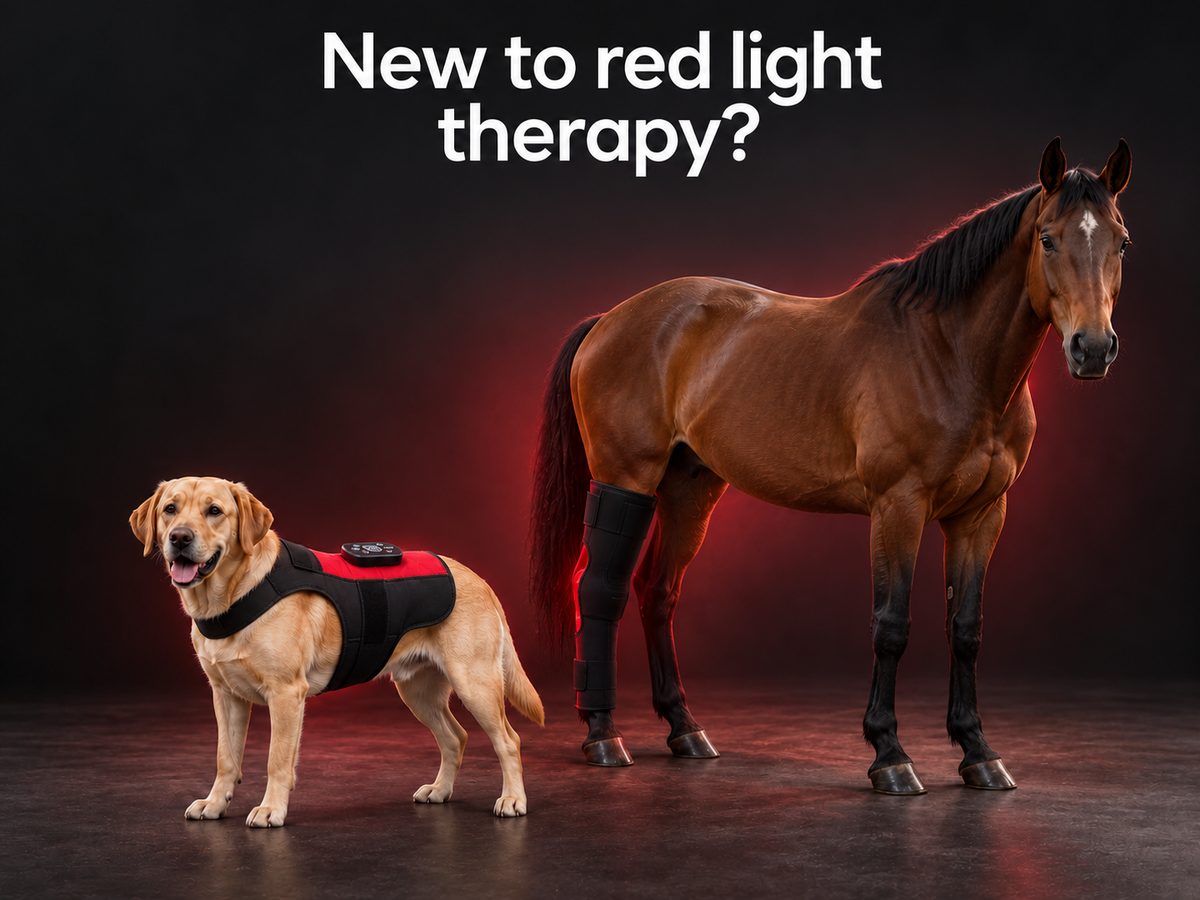
You want to make a thoughtful choice for your dog or horse. But between wavelengths, light output and different device designs, knowing where to start can feel complicated.
This guide explains the essentials: what red light therapy is, how devices differ and what to consider before adding one to your animal’s routine.
What is red light therapy?
Red light therapy uses selected wavelengths of light to interact with tissue. It is often called photobiomodulation, or PBM.
Devices may use visible red light, near-infrared light or a combination of both. Some use LEDs; others use lasers. These technologies deliver light differently, so they should not be treated as interchangeable.
Veterinary photobiomodulation has been studied for applications including pain management and recovery. Results depend on the condition, equipment and treatment protocol. Research using a clinical laser does not establish that a home LED product will produce the same outcome.
Understanding wavelengths
Wavelength describes the type of light a device emits. It is measured in nanometres, written as nm.
Two wavelengths you’ll see across parts of the BeamLab range are 660nm red light and 850nm near-infrared light.
| Light type | What it means |
|---|---|
| Red light, such as 660nm | Visible red light. More of its energy is generally absorbed in superficial tissue than longer near-infrared wavelengths. |
| Near-infrared light, such as 850nm | Invisible to the human eye. Used in photobiomodulation devices where transmission through superficial tissue is relevant. |
| Combined wavelengths | A device delivers more than one wavelength. This alone does not establish greater effectiveness. |
Wavelength influences how light is absorbed and scattered, but it does not guarantee a particular treatment depth. Veterinary research shows that coat and skin characteristics, alongside device settings, affect light transmission.
A useful rule: choose by the complete specification, rather than the wavelength alone.
Choosing a device type
The right format should suit the intended area, your available space and what your animal comfortably tolerates.
Wraps and wearable pads
Wraps position a flexible light surface around or over a particular area. Options include canine back and leg wraps, plus equine back, hind leg, hock and hoof wraps.
Compare the BackBeam canine back wrap, EquiBeam Leg Pro and EquiBeam Hock 76 for examples of different coverage and fitting designs.
They can be practical when you want localised placement without a separate stand. Check the measurements carefully: each design has its own fitting requirements.
A therapy wrap should not be assumed to provide compression, joint support or protection during exercise.
Therapy beds
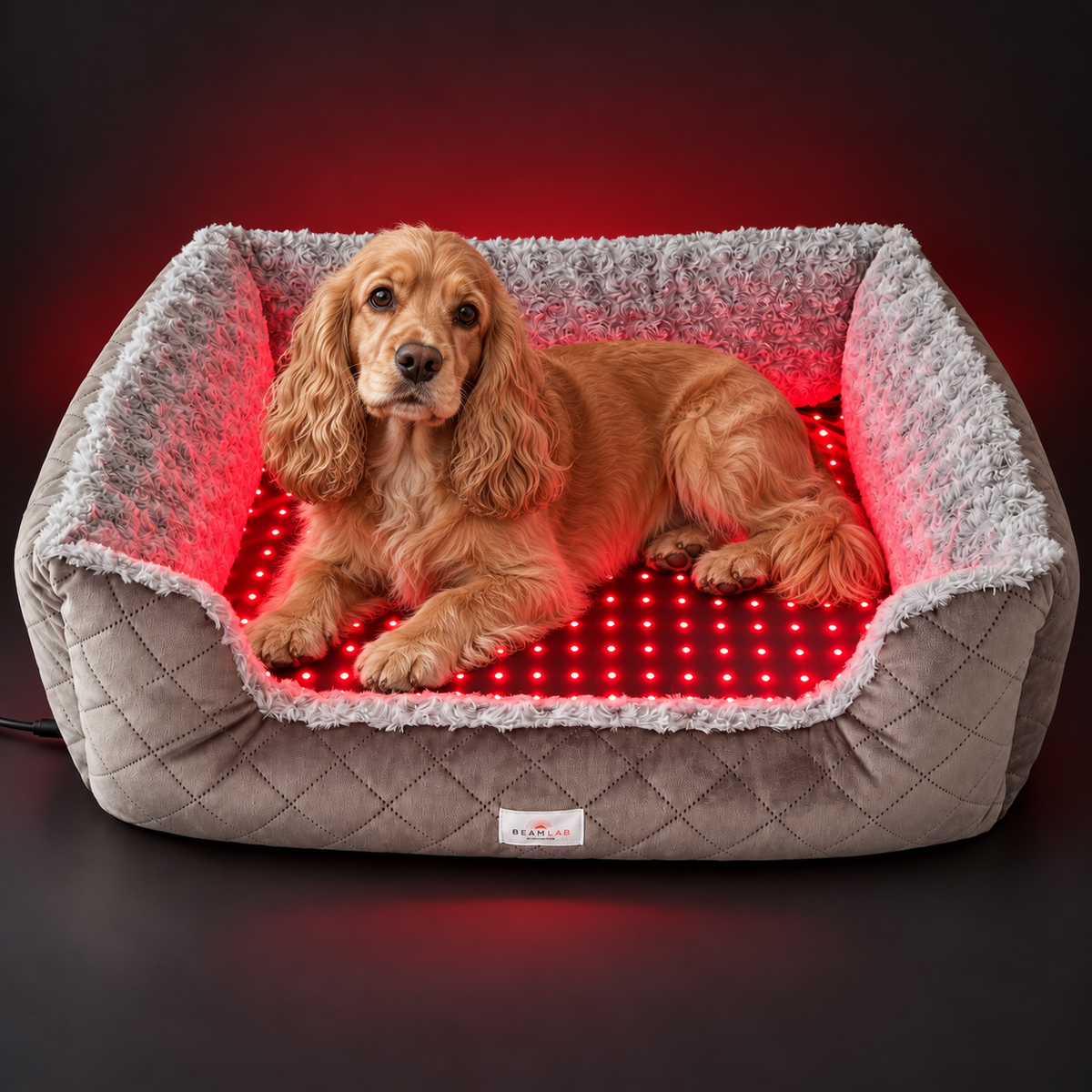
A therapy bed brings a light surface into a familiar resting space.
Check how the individual model works. BeamRest uses a removable centre cushion with a therapy pad underneath. BeamRest Pro has a reversible cushion, with the therapy surface on the other side.
Position the light surface as instructed for supervised sessions. Everyday resting with the therapy switched off is separate from an active session.
Panels and overhead systems
Panels provide contact-free illumination and may cover a broader exposed area, depending on their design.
The Beambar Equine Panel is one panel-format option. Review its specifications, setup and working-distance instructions before choosing.
They need secure positioning and the correct working distance. Your horse must also be comfortable standing near or beneath the equipment.
Check the intended purpose carefully: an infrared heat lamp or drying solarium is not automatically equivalent to an LED photobiomodulation panel.
Veterinary lasers
Veterinary lasers require their own operating protocols, training and eye protection. They are a different category from everyday LED beds and wraps.
A veterinary assessment should come first when pain or injury is the reason for treatment.
The specifications that matter
Irradiance: light intensity at a measured position
Irradiance is commonly expressed in mW/cm². It describes light power arriving per unit area at the measurement location.
Ask where the reading was taken, which setting was used and whether it represents an average across the surface or a single peak reading.
Two irradiance figures are difficult to compare without those details.
Power: check what the number describes
Electrical wattage describes power consumption. It does not tell you, by itself, how much light reaches the intended area.
Likewise, a larger LED count does not automatically mean better coverage or results.
Session settings
Distance, output, continuous or pulsed operation, and session duration all affect exposure. Use the instructions for your particular device.
There is no universal “ten minutes for every animal” rule, and a brighter-looking device is not necessarily delivering a more appropriate session.
Bringing light therapy into everyday care
Keep the routine calm and manageable.
-
Start with suitability. If your animal has pain, swelling, lameness, a wound or a diagnosed condition, speak to your vet before beginning.
-
Introduce the equipment switched off. Allow time to investigate it without pressure.
-
Prepare the intended area. Follow the manual’s requirements for a clean, dry coat or hoof.
-
Check placement. Fit wraps without overtightening, or position panels at the specified distance.
-
Use the recommended settings. Follow the device instructions and any veterinary plan.
-
Supervise throughout. Stop if your animal becomes restless, uncomfortable or unusually warm.
-
Finish and check. Switch off, remove wearable equipment and inspect the area before cleaning and storing the device.
Keep cables away from teeth and hooves. Follow the device’s eye-safety instructions, and avoid directing light into the eyes.
Daily wellness describes a routine—not permission to leave a device running all day or overnight.
What should you expect?
Set expectations around the specific product and its evidence.
A small controlled study reported improvements in dogs with hip osteoarthritis following a course of Class IV laser therapy. A separate controlled study using a red and near-infrared LED device found no clinically relevant benefit for experimental wound healing in horses. These findings concern particular devices and protocols, rather than every light therapy product.
Light therapy should fit alongside appropriate veterinary care, nutrition, movement and rest. Do not stop prescribed treatment because you have introduced a device.
If you are following a care plan, record useful observations—such as willingness to move or changes in comfort—and discuss them with your vet. A relaxed animal during a session is welcome, but it does not prove that an underlying condition has improved.
Your first step with BeamLab
Start with three questions:
-
Which area am I choosing the device for?
-
Will it fit my animal and their routine?
-
Are the specifications and instructions clear?
Explore the BeamLab canine and equine collections, check each product’s details and ask our UK-based support team if you need help comparing options.
A considered choice starts with understanding the essentials.

Leave a comment
This site is protected by hCaptcha and the hCaptcha Privacy Policy and Terms of Service apply.